
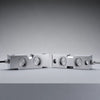
Load Cells: Types, Working & Buying Guide in India | Equal
, by Equal Store, 27 min reading time
, by Equal Store, 27 min reading time
A load cell is a transducer that turns force or weight into an electrical signal; a separate indicator converts that signal into a reading.
Almost all weighing load cells are strain gauge cells, using a Wheatstone bridge to measure how a metal body flexes under load.
The main types are single point, single-ended and double-ended shear beam, S-type, compression or canister column, compression disk, and miniature force sensors. Type matters more than brand.
To choose a cell, settle capacity, type, environment, accuracy or certification, and output, in that order.
S-type cells measure tension and compression and suit crane scales, hanging scales, and suspended tanks; capacities commonly run 10 kg to 10 t.
In India, load cells fall under HSN 9031 (usually 9031 80 00) with 18% GST.
Prices span roughly ₹1,000 for small single-point cells to ₹50,000+ for certified weighbridge column cells.
Equal supplies the full Keli range across India with calibration certificates, GST invoices, and pan-India delivery.
Every digital weighing scale, from the one on your kitchen counter to a 100 tonne truck weighbridge, hides the same small component at its core: a load cell. It is the part that actually senses weight. Everything else; the display, the wiring, the housing, the mounting hardware exists to power that sensor and turn its tiny electrical signal into a number you can read.
This guide covers what a load cell is, how it works, the main types and where each one fits, how to pick the right one for a weighing job, what they cost in India, and the tax and wiring details that catch first-time buyers off guard. It is written for scale manufacturers, maintenance engineers, procurement teams, and anyone building or repairing a weighing system.
If you already know the basics and simply want to source cells, Equal supplies the full Keli load cell range across India, from 1 kg single point cells to 200 tonne column cells, each with calibration certificates and a proper GST invoice.
Written and maintained by the Equal load cell team. Equal has supplied weighing components and instruments across India since 2001 and is the authorised Indian distributor for Keli Sensing Technology.
A load cell is a transducer that converts force or weight into a measurable electrical signal. When you place a load on it, the cell deforms by a microscopic amount, and that deformation changes an electrical output in direct proportion to the applied force. A digital indicator reads this signal and displays it as weight.
In plain terms, a load cell is the sensor that "feels" weight inside almost every electronic scale made today. It does not show a number by itself. It produces a small voltage that a separate indicator or controller reads, scales, and converts into kilograms or tonnes.
The vast majority of load cells sold in India are strain gauge load cells. A few specialised applications use other principles such as hydraulic or capacitive sensing, but for weighing, strain gauge cells dominate because they are accurate, stable, and affordable.
A strain gauge load cell works by measuring how much a metal body flexes under load. Strain gauges bonded to that body change their electrical resistance as it bends, and a Wheatstone bridge circuit converts that resistance change into a voltage proportional to the weight.
Here is the sequence, step by step:
A load is applied to the cell's spring element, usually a precisely machined block of aluminium alloy or alloy steel.
The element flexes by a tiny, elastic amount. Well within the metal's limits, so it springs back when the load is removed.
Strain gauges deform with it. These are thin foil grids glued to the surface. As the metal stretches or compresses, the foil's electrical resistance changes.
A Wheatstone bridge reads the change. Four gauges are wired into a bridge so that two stretch while two compress. This arrangement maximises sensitivity and cancels out most temperature drift.
The bridge outputs a small voltage, typically a few millivolts, that rises and falls in step with the load.
An amplifier or indicator scales it into a usable weight reading.
The output is small on purpose. A standard 2 mV/V cell fed with 10 volts of excitation produces just 20 millivolts at full load. That is why load cells almost always need a signal conditioner or a weight indicator to turn the raw millivolt signal into something useful.
Two things make a good strain gauge load cell trustworthy: the quality of the machined spring element, which governs how repeatably it flexes, and the bonding and matching of the gauges, which governs accuracy and long-term stability.
A typical strain gauge load cell has four functional parts:

|
Spring element (the body): the machined metal that flexes under load. Aluminium for lighter, lower-capacity cells; alloy or stainless steel for heavy and harsh-duty cells.
Strain gauges: the foil sensors bonded to the body, wired as a Wheatstone bridge.
Sealing and housing: potting, welded covers, or glued membranes that keep moisture and dust out. The better the seal, the higher the IP rating.
Cable: a shielded 4-wire or 6-wire cable carrying excitation in and signal out.
The load path, meaning where and how the force enters the cell, is engineered into the body shape. That is what separates a single point cell from a shear beam or an S-type, which we cover next.
Before comparing types, it helps to read a datasheet. These are the specifications that matter most when selecting a cell.
| Specification | What it means | Typical values |
|---|---|---|
| Rated capacity (E max) | Maximum load the cell is built to measure | 1 kg to 200 t, depending on type |
| Rated output | Signal at full load, per volt of excitation | 1 to 3 mV/V (2 mV/V is most common) |
| Accuracy class (OIML R60) | Legal-for-trade grade, set by number of divisions | C3 (3000 divisions) is common; C6 for higher precision |
| Combined error | Total of non-linearity, hysteresis and repeatability | ±0.02% to ±0.05% of full scale for industrial cells |
| Excitation voltage | Power supplied to the cell | 5 to 15 V DC (10 V is typical) |
| Safe overload | Load before permanent damage becomes a risk | around 150% of rated capacity |
| Ultimate overload | Load before structural failure | 200% to 300% of rated capacity |
| Ingress protection (IP) | Dust and water resistance | IP65 for indoor use up to IP69K for washdown |
| Input/output resistance | Bridge resistance | Roughly 350 to 400 ohms |
Two quick rules of thumb from the field:
Never size a cell right at its rated capacity: Leave headroom for shock loads, off-centre placement, and the dead weight of the platform itself. A common practice is to choose a capacity comfortably above the heaviest expected load.
Match the IP rating to the environment, not the budget: A cheaper IP65 cell installed in a wet outdoor pit will fail long before a correctly specified IP68 cell, and replacing a pit-mounted cell is expensive.
Accuracy class is governed internationally by OIML Recommendation R 60, the metrological standard for load cells. In India, weighing instruments used for trade must also comply with the Legal Metrology Act, 2009, administered by the Department of Legal Metrology.
The main types of load cells are single point, single-ended shear beam, double-ended shear beam, S-type (S-beam), compression or canister (column), compression disk (pancake), and miniature force sensors. Each has a shape that suits a particular load path, capacity range, and application.
Choosing the right type is usually more important than choosing the brand. A mismatched type will read inaccurately no matter how good the cell is. Here is how they compare.
| Load cell type | Typical capacity | Force measured | Output | Best-suited applications |
|---|---|---|---|---|
| Single point | 1 kg to 300 kg | Compression | ~2 mV/V | Bench, retail, postal and price-computing scales |
| Single-ended shear beam | 5 kg to ~1,000 kg | Compression | ~2 mV/V | Floor scales, small platform scales, tank weighing |
| Double-ended shear beam | 50 kg to 20 t | Compression | 1 to 3 mV/V | Platform scales, truck scales, hopper scales |
| S-type (S-beam) | 10 kg to 10 t | Tension and compression | 2 to 3 mV/V | Crane and hanging scales, tank weighing in tension, force testing |
| Compression/canister (column) | 500 kg to 200 t | Compression | 1 to 2 mV/V | Weighbridges, silo and tank weighing, heavy platforms |
| Compression disk (pancake) | 100 kg to 100 t | Compression | ~2 mV/V | Press force, structural monitoring, material testing |
| Miniature force sensor | 0.1 kg to 500 kg | Tension and compression | 1 to 2 mV/V | Laboratory, R&D, embedded and testing applications |
Single point cells are built to tolerate off-centre loading, which is why they sit under small platform scales where the item can land anywhere on the pan. One cell carries the whole platform. They are usually aluminium, low in cost, and ideal for retail, postal, counting, and price-computing scales up to a few hundred kilograms.
Shear beam cells measure the shear stress in a beam that is fixed at one end with the load applied at the other (single-ended) or supported at both ends with the load in the middle (double-ended). Single-ended shear beams suit floor scales and tank weighing. Double-ended shear beams handle the heavier, more dynamic loads of platform scales and truck scales, and are a workhorse of the weighbridge industry.
Named for their S shape, these cells measure both tension (pulling) and compression (pushing). That makes them the natural choice for crane scales, hanging scales, and any tank or hopper weighed in suspension. They also appear widely in force measurement and material testing rigs.
For the heaviest work, column cells carry load in pure compression. Self-centering rocker-column designs are the benchmark for truck weighbridges, where a single scale may use several cells rated in tens of tonnes each. Canister and column cells also handle silo, tank, and hopper weighing at high capacity, up to 200 tonnes per cell.
 |
To choose a load cell, work through five questions in order: how much weight it will support, what type fits the load path, what environment it will live in, what accuracy or certification the job requires, and what output the indicator expects. Get these right, and the cell will read accurately for years.
Here is the selection framework we walk our own customers through.
1. Capacity: Add up the maximum load plus the dead weight of the platform or vessel, then add headroom for shock and off-centre loading. In multi-cell systems, divide the total across the number of cells, then size each cell above its share.
2. Type: Match the shape to the load path. Compression job on a small platform points to a single point cell. A heavy platform or truck points to a shear beam or column. Hanging or tension job points to an S-type. This step matters more than any spec sheet number.
3. Environment: Indoor and dry can use IP65. Dusty, wet, or washdown areas need IP67, IP68, or IP69K. Corrosive settings call for stainless steel over nickel-plated alloy steel. Outdoor pit installations, common in weighbridges, need the highest sealing you can get.
4. Accuracy and certification: If the scale is used for trade, meaning goods are bought or sold by weight, it must use legal-for-trade cells, typically OIML C3, and the complete instrument must be model-approved under India's Legal Metrology rules. Internal process weighing can often use a lower class.
5. Output and compatibility: Confirm the mV/V rating, excitation range, and whether your indicator expects analog (mV) or digital (for example RS485) signal. Multiple cells in one system should be output-matched so they share load evenly.
A short worked example: a factory wants a 2 tonne floor scale for finished goods in a dry indoor area, not for trade. That points to four single-ended shear beam cells of around 500 kg to 1 tonne each, IP67, standard 2 mV/V, wired through a junction box to a basic indicator. Simple, robust, and affordable.
Different scale formats rely on different cell types, and knowing the pairing speeds up both buying and repair.
Bench and retail scales: one single-point cell.
Small to medium platform scales: one single-point cell, or four single-ended shear beams for larger platforms.
Floor and pallet scales: four single-ended or double-ended shear beam cells, one per corner, through a summing junction box.
Tank, hopper, and silo weighing: three or four cells, compression column or shear beam for cells in compression, S-type for vessels weighed in suspension, usually with weigh module mounting kits.
Truck weighbridges: typically six to ten double-ended shear beam or column cells, sealed to IP68 or IP69K, feeding a junction box and a weighbridge indicator.
A weighbridge deserves special care because the cells sit in an outdoor pit, carry enormous dynamic loads, and are costly to replace. Sealing, overload protection, lightning protection, and rodent-resistant cable all matter here. The self-centering rocker-column design, which lets each cell return to vertical as the platform shifts under a moving vehicle, has become the industry benchmark for truck scales.
An S-type load cell measures both tension and compression, which makes it the right choice whenever a load hangs from the cell or pulls against it. It suits crane scales, hanging scales, suspended tanks and hoppers, rope and cable tension, and force testing. Capacities commonly run from around 10 kg to 10 tonnes.
The S shape lets force enter through threaded fittings at the top and bottom, so the cell works equally well being pulled apart or pushed together. That flexibility is why S-beams turn up in so many places a beam or column cell cannot go.
Best-suited loads and jobs for an S-type cell:
Hanging and crane scales, where the load is lifted and weighed in mid-air.
Tank and hopper weighing in suspension, where the vessel hangs from cells rather than resting on them.
Tension measurement on ropes, cables, winches, and web lines.
Push-pull force testing in labs and on production rigs.
Retrofit weighing where there is no room for a platform underneath.
You can buy S-type load cells in India directly from Equal. As the authorised Indian distributor for Keli Sensing Technology, Equal supplies Keli S Beam cells rated from 10 kg to 10,000 kg for tension and compression duty, alongside eight other cell categories. Every cell ships with a calibration certificate and a GST invoice, with pan-India delivery from stock in Jaipur.
To get an S-type cell, share your capacity and application and Equal's team will recommend the right Keli model, usually with pricing within 24 hours. Start on the load cell page or message the team on WhatsApp at +91 73000 93963.
A load cell amplifier boosts the cell's small millivolt output into a standard signal an instrument can use, such as 0 to 10 V, 4 to 20 mA, or a digital output like RS485. You need one whenever your controller, PLC, or display cannot read raw millivolts directly.
Because a load cell puts out only a few millivolts, that signal is too weak and too noise-prone to feed straight into most automation hardware. An amplifier, sometimes called a transmitter or signal conditioner, sits between the cell and the system and does three jobs: it powers the cell with a stable excitation voltage, amplifies the return signal, and converts it to a standard analog or digital output.
Where do you need one?
A weighing indicator already contains this circuitry, so a simple scale plus indicator needs no separate amplifier.
Feeding a PLC or DCS for batching, filling, or process control usually does need a dedicated amplifier or weight transmitter.
Long cable runs or multiple cells benefit from amplifiers with sense lines and, in weighbridges, from junction boxes that sum several cells before the signal is amplified.
Most load cells use either a 4-wire or a 6-wire cable. The four core connections are Excitation+ (E+), Excitation- (E-), Signal+ (S+), and Signal- (S-). A 6-wire cell adds Sense+ and Sense- lines to compensate for voltage loss over long cables.
The catch that trips up many installers: wire colours are not standardised across manufacturers. A colour that means Excitation+ on one brand can mean something else on another. A widely used convention, followed by Keli and several others, is:
Red: Excitation + (input +)
Black: Excitation - (input -)
Green: Signal + (output +)
White: Signal - (output -)
On 6-wire cells, Blue and Brown (or Yellow) carry the two Sense lines, with a bare or foil shield for grounding.
Treat that list as a common starting point, not gospel. Always confirm against the datasheet or calibration certificate that came with your specific cell before wiring it in. Swapping the signal pair inverts the reading, confusing the excitation and signal pairs gives a wrong or zero output, and feeding excitation voltage into an indicator's signal input can damage the indicator.
If you are combining several cells, they connect through a summing junction box that balances their outputs before sending a single signal to the indicator.
Load cell prices in India range from around ₹1,000 for a small aluminium single point cell to ₹50,000 or more for a high-capacity certified weighbridge column cell. Price depends on capacity, type, material, certification, and order quantity far more than on brand alone.
The table below gives indicative market ranges as of mid-2026, alongside Equal's own listed prices for Keli industrial cells. Treat these as starting points for planning, not firm quotes. The lowest figures on listing sites usually apply to the smallest capacities, and certified or high-capacity cells cost considerably more.
| Load cell type or use | Indicative price range (India) |
|---|---|
| Small single point/table top (a few kg) | ₹1,000 to ₹6,000 |
| S-type / S-beam (kg to a few tonnes) | ₹1,500 to ₹15,000 |
| Single-ended shear beam (medium) | ₹2,000 to ₹15,000 |
| Double-ended shear beam (truck/hopper) | ₹9,000 to ₹25,000 |
| Compression/canister column (weighbridge, up to 200 t) | ₹15,000 to ₹50,000+ |
| Keli 30/40 t alloy steel cell (Equal, listed) | ₹10,990 |
| Keli certified weighbridge and industrial cells (Equal, listed) | ₹20,990 |
Prices verified from Equal's product listings and current Indian supplier listings. Bulk and OEM orders are quoted separately and usually land below single-unit pricing.
Load cells are classified under HSN code 9031 in India, most commonly the 8-digit code 9031 80 00, which covers measuring or checking instruments not specified elsewhere. The GST rate is 18%, and it has stayed at 18% since GST was introduced in 2017.
A few practical notes for procurement and accounts teams:
9031 80 00 is the code most widely used in Indian import and export shipments for a standalone load cell. Load cell columns and parts sometimes appear under 9031 90 00 (parts and accessories).
A complete weighing machine is classified separately, under heading 8423 (weighing machinery), which also attracts 18% GST. So whether the item is billed as a load cell or as a finished scale, the GST rate is the same.
Heading 8423 specifically excludes very high-precision balances (sensitivity of 5 centigrams or better), which fall under heading 9016.
HSN classification and rates are updated by government notification. For anything with tax or customs exposure, confirm the current position with your CA or against the latest CBIC notification.
Equal issues a proper GST invoice with every load cell order, which matters for input tax credit and for corporate or government procurement.
 |
Equal is the authorised Indian distributor for Keli Sensing Technology and supplies the complete Keli load cell range to OEMs, scale manufacturers, weighbridge operators, system integrators, and industrial buyers across the country.
What Equal offers load cell buyers:
Nine load cell categories, covering double-ended beam, single-ended beam, S-beam, single point, canister and column, compression disk, force sensors, weigh module kits, and accessories such as junction boxes and mounting hardware.
Genuine, certified product with calibration certificates, test reports, and OIML or CE compliance documentation on every order.
Pan-India delivery from stock in Jaipur, with import handling for special specifications.
OEM and bulk pricing with dedicated account handling from enquiry to dispatch.
A proper GST invoice and full purchase-order support for corporate and PSU procurement.
Technical support to help you select the right capacity, mounting, output, and sealing for your application.
The process is built for procurement teams: share your capacity, quantity, and application, get a model recommendation and quote (usually within 24 hours), confirm the order, and receive the cells with a calibration certificate, test report, and GST invoice.
Start here: browse the load cell collection, open the load cell distributor page to request a quote, Call & WhatsApp Equal at +91 73000 93963.
Expert Insights: Mistakes to Avoid
A few patterns come up again and again when weighing systems misbehave. Most are avoidable at the buying stage.
Undersizing capacity: Buyers forget the platform's own weight and the shock of items being dropped on. The cell reads poorly or fails early. Always add headroom.
Picking the wrong type for the load path: A compression cell forced into a tension job, or a single point cell used well off centre on an oversized platform, will never read accurately. Match the shape first.
Under-specifying the IP rating: The most common cause of premature failure in outdoor and washdown installations. Water gets in, the bridge drifts, the cell dies.
Ignoring certification for trade use: Using a non-legal-for-trade cell where goods are sold by weight is both inaccurate and non-compliant under the Legal Metrology Act.
Wiring by colour alone: Because colour codes vary by brand, always verify against the datasheet. A reversed pair is a frustrating way to lose an afternoon.
Mixing mismatched cells in one system: Cells in a multi-point scale should be output-matched so they share load evenly; otherwise, corners read differently.
A load cell is a small sensor doing a big job, and getting the weighing right comes down to a few clear decisions: the correct type for the load path, enough capacity with headroom, the right sealing for the environment, and the certification the application demands. Sort those out and almost any quality cell will serve you well for years.
When you are ready to buy, Equal supplies the full Keli load cell range across India, from 1 kg single point cells to 200 tonne column cells, each with a calibration certificate and a GST invoice, backed by technical support to help you choose. Browse the load cell collection or request a quote on the load cell page.
A load cell is the sensor inside a weighing scale that converts weight into an electrical signal. It does not display anything on its own; an indicator reads its signal and shows the weight.
Strain gauges bonded to a metal body change their electrical resistance as the body flexes under load. A Wheatstone bridge circuit turns that resistance change into a voltage that is proportional to the weight applied.
Single point, single-ended shear beam, double-ended shear beam, S-type (S-beam), compression or canister column, compression disk (pancake), and miniature force sensors. Each suits a specific load path and capacity range.
Match the type to the job. Small platform or retail scales use single point cells; floor and platform scales use shear beams; truck weighbridges use double-ended shear beam or column cells; hanging or tension jobs use S-type cells. Then size the capacity above your heaviest expected load and pick an IP rating to match the environment.
A single point cell carries a whole small platform on one cell and tolerates off-centre loading, ideal for bench and retail scales. A shear beam cell measures shear in a supported beam and handles heavier platform and industrial weighing, usually with several cells sharing the load.
You can buy S-type load cells from Equal, the authorised Indian distributor for Keli, in capacities from 10 kg to 10,000 kg. S-type cells measure both tension and compression, which makes them best suited to crane scales, hanging scales, tanks and hoppers weighed in suspension, and push-pull force testing.
It is the cell's output signal at full load per volt of excitation. A 2 mV/V cell powered with 10 volts gives 20 millivolts at rated capacity. The number tells your indicator or amplifier how strong a signal to expect.
Most truck weighbridges use six to ten cells, usually double-ended shear beam or column type, sealed to IP68 or IP69K and connected through a summing junction box to a weighbridge indicator.
Load cells are classified under HSN 9031, most commonly 9031 80 00, with a GST rate of 18%. A complete weighing machine falls under heading 8423, which also carries 18% GST. Confirm the current position with your CA for tax-sensitive transactions.
An amplifier boosts a load cell's small millivolt output into a standard signal such as 0 to 10 V, 4 to 20 mA, or RS485. You need one when feeding a PLC or automation system directly. A standard scale with a weighing indicator already has this built in.
The four core connections are Excitation+, Excitation-, Signal+, and Signal-, with two extra Sense lines on 6-wire cells. A common convention (used by Keli and others) is red for Excitation+, black for Excitation-, green for Signal+, and white for Signal-. Colour codes vary by brand, so always check the datasheet.
OIML C3 is an accuracy class under OIML R 60, indicating a cell rated for 3000 divisions. Scales used for trade, where goods are bought or sold by weight, generally need C3 cells and full model approval under Legal Metrology rules. Internal process weighing can often use a lower class.
Yes. S-type (S-beam) cells and many miniature force sensors are designed to measure both pulling (tension) and pushing (compression) forces, which is why they are used in crane scales and force testing.