
Best Multipurpose Ladder for Home Use in India (2026)
, by Deepa Singh, 26 min reading time
, by Deepa Singh, 26 min reading time
Match the size to your home: 10 to 12 ft for standard flats, 12 to 15 ft for staircases and taller ceilings, 15 to 19 ft for terrace and high-reach access. Ask anyone who has tried to change a ceiling fan while balancing on a plastic stool, and you get the same verdict: the right ladder is not a luxury; it is basic home infrastructure. A typical Indian home asks a lot of any ladder. You have tube lights and fans at ceiling height, storage lofts above the wardrobes, curtain rods well out of arm's reach, exterior walls that need the odd coat of paint, and a water tank on the terrace that always seems to need attention at the worst possible time.
For years, the standard answer was to own two or three separate ladders, or to make do with a wobbly step stool and a lot of optimism. A multipurpose ladder changes that equation. One well-built unit folds and reconfigures to cover almost every job a household throws at it, and it stores in the space a single ladder would take.
This guide walks through what actually matters when you buy one in 2026, how the safety standards work in India, and which multipurpose ladder holds up best for everyday home use. We have kept it practical, because a ladder is one of the few purchases where getting it slightly wrong has real consequences.
Which multipurpose ladder is best for home use in India?
For most Indian homes, a 10 to 12 foot aluminium multipurpose ladder that is EN131 certified to a 150 kg load offers the best balance of reach, stability and storage. The Equal multipurpose aluminium range fits this profile well, with lockable hinges, anti-slip feet and a build rated to roughly double the weight of an average adult.
A multipurpose ladder is a single foldable ladder that converts into several different configurations, so one unit can do the work of a step ladder, an extension ladder, a staircase ladder and a low working platform. It uses lockable hinges at the joints, which let you set each section at a fixed angle and change the shape to suit the task.
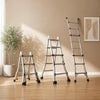
The versatility comes from the hinge system. Instead of a fixed frame, the ladder is built from hinged sections that lock into place. That single design choice is what lets it switch roles. The common configurations you will use at home are:
A multipurpose ladder suits Indian homes because it handles varied indoor and outdoor tasks, works on staircases, folds down for flat storage in a cupboard or under a bed, and removes the need to buy and store several separate ladders. For flats and compact houses where every square foot counts, that combination is hard to beat.
|
|
A few realities of Indian homes make the case on their own.
Storage is tight: In an apartment, there is rarely room for a full-height extension ladder standing in a corner. A multipurpose ladder folds to a slim depth and slides into a utility cupboard, a storeroom or the boot of a car. The Equal 10-foot model, for instance, folds to around 21 cm deep.
The tasks are varied: One weekend you are cleaning fan blades from an A-frame in the living room, the next you are leaning against the outside wall to seal a monsoon leak. A single-purpose ladder forces a compromise. A multipurpose one adapts.
Staircases are everywhere: Duplexes, independent houses and buildings with internal stairs create a specific problem: you cannot safely stand a normal ladder on steps. The stairway configuration is built for exactly this, and it is often the feature that convinces people to switch.
It works out cheaper: Buying a step ladder, an extension ladder, and a small platform separately costs more, takes up more space, and means three things to maintain. One quality multipurpose ladder consolidates all of that.
This is the part worth slowing down for. Ladders vary enormously in quality, and the differences are not always visible at a glance. Here is what separates a ladder you will trust for a decade from one you will quietly stop using after a scare.
Aluminium is the best all-round material for a home multipurpose ladder because it is light enough to carry and reposition easily, strong for its weight, and does not rust in humid or coastal conditions. Steel and fibreglass have their places, but for everyday household use aluminium wins on practicality.
|
Material |
Weight |
Strength |
Rust resistance |
Electrical safety |
Best for |
|
Aluminium |
Light |
High for its weight |
Excellent, does not rust |
Conducts electricity, keep clear of live wires |
Everyday home use, most tasks |
|
Steel |
Heavy |
Very high |
Can rust over time |
Conducts electricity |
Fixed industrial use where weight is not an issue |
|
Fibreglass (GRP) |
Heavy |
High |
Excellent |
Non-conductive, safest near electricity |
Dedicated electrical work |
|
Wood |
Heavy |
Moderate |
Warps and degrades with moisture |
Non-conductive when dry |
Traditional use, now uncommon |
One honest caveat: aluminium conducts electricity. For most home jobs this is a non-issue, but if you are working directly on live electrical fittings or near overhead lines, a fibreglass ladder is the safer choice. For general household reach, cleaning, painting and maintenance, a good aluminium ladder is the sensible pick, and it is what the large majority of Indian homes actually need.
Check the maximum load, and remember it has to carry you plus your tools, plus whatever you are holding. Under the EN131 standard, a compliant ladder is rated to a maximum total load of 150 kg, which is roughly double the weight of an average adult once you account for the safety margin. Treat any ladder rated below that, for example an older 90 kg unit, as a warning sign that it does not meet current standards.
This is the single most useful filter when buying. A ladder marked and independently tested to EN131 has passed defined tests for slip resistance, stability, rung strength and durability. It is the benchmark serious buyers look for, and we explain it in full in the next section. If a ladder carries no recognised certification, ask the seller for the test certificate before you buy.
The hinges are the heart of a multipurpose ladder, so they deserve close attention. Good hinges lock positively at each position, hold firm under load, and release cleanly when you want to change configuration. Independent hinge locks, where each joint locks on its own, unlock more configurations and give you finer control over the angle. Cheap hinges that feel loose or vague are a hard no, because a hinge that slips mid-task is how accidents happen.
Buy for the tasks you actually do, not the tallest job you can imagine. The size printed on a multipurpose ladder, say 12 feet, usually refers to its length when fully extended as a straight ladder. Folded into an A-frame, its standing height is roughly half that. Your working reach is higher again, because you add your own arm's reach to the top of the ladder. As a rough guide for Indian homes:
|
Ceiling / task height |
Suggested multipurpose ladder size |
|
Standard flat, around 10 ft ceilings, fans, lights, shelves |
10 to 12 ft |
|
Taller ceilings, stairwell work, single-storey exterior |
13.5 to 15 ft |
|
High ceilings, double-height rooms, terrace and second-floor access |
15 to 19 ft |
A ladder you cannot store conveniently is a ladder you will resent. Look at the folded dimensions. The best multipurpose ladders collapse to a slim depth that fits a cupboard, a gap behind a door or a car boot. This is where they earn their keep in apartment living.
Indian homes are full of smooth surfaces, marble, vitrified tiles and polished concrete, that a ladder can slide across. Wide, anti-slip rubber feet are essential, not optional. On taller ladders, a stabiliser bar at the base widens the stance and resists sideways tipping. Under EN131, any leaning ladder over three metres is required to have one.
If a ladder is a struggle to carry, it stays folded in the corner. Aluminium keeps the weight manageable. Some multipurpose models add built-in wheels, so you can tilt and roll the ladder to reposition it rather than lifting the full weight, which is a small feature that makes a real difference on a long job.
India does not currently have a dedicated Bureau of Indian Standards (BIS) product certification specifically for household multipurpose aluminium ladders. The relevant Indian code, IS 3696 Part 2, governs the safe use of ladders in construction, while consumer buyers rely on the European EN131 standard as the meaningful quality benchmark. Understanding this gap is what lets you buy well.
Here is the fuller picture, because the standards landscape confuses a lot of shoppers.
IS 3696 (Part 2): 1991 is the BIS Code of Safety for ladders. It is a construction and maintenance safety code, published by the Bureau of Indian Standards, that classifies ladder types and lays down safe-use rules. Notably, it recommends that portable ladders are not used above four metres, that leaning ladders are set at roughly a 75 degree angle, and that both the top and bottom are secured against slipping. These are use guidelines rather than a manufacturing certification for consumer products.
IS 4571 covers aluminium extension ladders, but specifically for fire brigade use, so it does not apply to the household ladder you buy for home tasks.
Because there is no mandatory consumer certification unique to home multipurpose ladders in India, the EN131 mark carries real weight. EN131 is the harmonised European standard for portable ladders, and a ladder certified to it has been independently tested for the things that actually cause accidents. Under the current EN131 revision:
Ladders are rated to a maximum total load of 150 kg.
They are tested for slip resistance, torsion, stability and durability, not just static strength.
The standard splits ladders into Professional and Non-Professional classes, where professional-grade units pass a far tougher durability cycle test.
Leaning ladders over three metres must include a stabiliser bar.
You can read more about the standard from the Ladder Association, the recognised UK authority on ladder safety. The practical takeaway for an Indian buyer is simple. In the absence of a home-specific BIS mark, an EN131 certification is the clearest signal that a ladder has been built and tested to a credible, independent safety benchmark.
Ladders feel harmless, which is exactly why people get hurt on them. A little data reframes how seriously to take the purchase.
According to the US National Institute for Occupational Safety and Health (NIOSH), falls remain a leading cause of unintentional injury, and over the past decade a large share of fatal falls have involved a ladder. NIOSH data attributes roughly 40% of ladder-related injuries to the ladder sliding out at the base because it was set up at the wrong angle, which is why the 75 degree setup rule matters so much. NIOSH also stresses that selecting a ladder of the correct size and duty rating is central to avoiding instability and structural failure.
Crucially, these injuries are not confined to worksites. NIOSH is explicit that many ladder injuries happen at home. A peer-reviewed trauma study from New South Wales, Australia, published in the Journal of Safety Research, found that older adults using ladders in non-work settings were the highest-risk group, with the majority of serious falls occurring from between one and five metres, well within the range of everyday household tasks.
The pattern across the research is consistent: most ladder injuries are preventable, and they come down to two things, the ladder you choose and the way you set it up. A stable, correctly rated, certified ladder removes a large slice of the risk before you have even climbed a rung.
|
|
For reliable everyday home use in India, the Equal aluminium multipurpose ladder range is a standout choice. Every model is EN131 certified to a 150 kg load, built from corrosion-resistant aluminium alloy, and fitted with lockable hinges and anti-slip feet. The range spans 10 to 19 feet, carries a two-year warranty, and ships free across India. It hits the exact specification this guide has been building toward.
Equal has been in the ladder business since 2001, and the multipurpose line reflects that focus. Rather than a generic import, the range is designed around the way people actually work at home and on site. A single unit converts between A-frame, straight extension, stairway scaffold, M-shape and working platform modes, so it covers the full spread of household jobs discussed earlier.
Here is what makes the range a sensible default for an Indian home:
EN131 certified, 150 kg rated. Independently tested to the benchmark that matters, and rated to roughly double the weight of an average adult.
Aluminium alloy build. Light enough to carry and reposition, corrosion-resistant for humid and coastal conditions, and built to last without rusting.
Lockable hinges. Each joint locks securely at the angle you set and releases cleanly to reconfigure, giving you confidence under load.
Anti-slip rubber feet. Wide, grippy feet designed for the tile, marble and concrete surfaces common in Indian homes.
Compact folded depth. The 10-foot model folds to around 21 cm, so it stores in a cupboard or a car boot rather than dominating a room.
Delivered fully assembled. No tools, no installation, ready to use out of the box.
Two-year warranty and free delivery across India, with a seven-day returns window.
The range is offered in two series, which makes choosing easier:
Standard multipurpose ladder with built-in wheels. The wheels let you tilt and roll the ladder to reposition it without lifting the full weight, which is a genuine convenience on longer jobs and larger homes.
7-in-1 ladder with independent lockable hinges. Each hinge locks on its own, unlocking more configurations including M-shape and a platform scaffold mode, with platform plates included on the larger models. This is the pick for serious DIYers and anyone who wants maximum versatility.
You can view the full line-up, sizes and current pricing on the Equal aluminium multipurpose ladder collection. At the time of writing, the range starts with competitive pricing for the 10-foot model, and every option carries the same EN131 certification and warranty backing.
If your priority is the most compact possible storage rather than multiple configurations, it is worth knowing Equal also makes a telescopic ladder range that collapses to under a metre, and simple A-type ladders for straightforward two-mode use. For most households wanting one ladder that does nearly everything, though, the multipurpose range is the right call.
The best ladder is the one matched to your home. Here are four common scenarios and the sensible pick for each.
You live in a standard flat with roughly 10-foot ceilings. Your tasks are fans, tube lights, curtain rods, high shelves, and the occasional bit of painting. A 10 to 12 foot multipurpose ladder is ample, and it folds away neatly in an apartment. If storage is your single biggest constraint, a 10.5 foot telescopic ladder is an even more compact alternative for these indoor jobs.
You have an independent house or duplex with an internal staircase. The stairway configuration is the feature you cannot do without, because standing a normal ladder on steps is unsafe. A multipurpose ladder in the 12 to 15 foot range handles both the staircase and higher ceilings comfortably.
You are a keen DIYer who paints, repairs, and maintains regularly. You want maximum versatility and a platform mode for longer stretches of work. The 7-in-1 series, with its independent hinges and platform plates, is built for exactly this kind of use.
You need occasional access to a terrace, water tank or second-floor exterior. Reach is the priority. A 15 to 19 foot multipurpose ladder, used in straight extension mode against the wall, gives you the height for these bigger jobs while still folding for storage.
|
|
Owning a good ladder is half the job. Using it correctly is the other half. A safe setup takes thirty seconds and prevents almost every common fall.
How to set up and use a multipurpose ladder safely, step by step:
Set up on firm, level ground: Never place a ladder on loose tiles, a rug that can slide, or uneven paving. On stairs, use the stairway configuration so all feet sit level.
Check every hinge is locked: Before you climb, confirm each lock is fully engaged. Give the ladder a gentle shake to test it.
Get the angle right when leaning: For straight or extension mode, set the ladder at roughly a 75 degree angle. A useful rule is one unit of base distance from the wall for every four units of height.
Keep three points of contact: Two hands and one foot, or two feet and one hand, on the ladder at all times as you climb and work.
Do not overreach: Keep your belt buckle within the width of the rails. If you have to lean out, get down and move the ladder instead.
Respect the load limit: Count your own weight plus tools and materials, and stay within the rated maximum.
Mind electricity: Aluminium conducts, so keep the ladder well clear of live wires and overhead lines, and use fibreglass for direct electrical work.
Wear proper footwear: Closed, non-slip shoes, never bare feet or slippers, which are a common cause of household slips.
A little maintenance keeps a ladder safe and extends its life well beyond its warranty.
Wipe it down after outdoor or painting jobs, so grit and paint do not build up on the rungs and feet.
Inspect before each use. Look for bent sections, loose rivets, cracked feet or hinges that no longer lock crisply. Retire any ladder that fails this check.
Keep hinges clean and moving freely. A light lubricant on the pivots keeps the locking action smooth.
Store it folded and flat, ideally off the ground and away from constant damp. Aluminium will not rust, but clean, dry storage keeps the feet and hinges in good shape.
A ladder is one of those purchases where the cheapest option is rarely the smartest one. The right multipurpose ladder pays you back every time you avoid balancing on a chair, every time you reach a job cleanly and safely, and every time you fold it away without giving it a second thought. The specification to aim for is clear: aluminium for practicality, a 150 kg rating for capacity, EN131 certification for peace of mind, and a size matched to your home rather than to the tallest job you can picture.
On all of those counts, the Equal aluminium multipurpose range is a dependable choice for Indian homes. It is certified where it counts, built to last, sized for real households, and backed by a warranty and free delivery. For a tool you will rely on for years, that combination is exactly what everyday reliability looks like.
Browse the full range on the Equal multipurpose ladder collection and pick the size that fits your home.
For most Indian homes, a 10 to 12 foot aluminium multipurpose ladder that is EN131 certified to 150 kg is the best choice, because it balances reach, stability and compact storage. The Equal multipurpose aluminium range fits this profile, with lockable hinges, anti-slip feet and a range spanning 10 to 19 feet.
Aluminium is better for general home use because it is lighter, easier to carry and reposition, and rust-proof. Fibreglass is heavier and pricier but non-conductive, so it is the safer choice only when you are working directly on live electrical fittings. For everyday tasks, aluminium is the practical pick.
EN131 is the European safety standard for portable ladders. A certified ladder has been independently tested for load capacity, slip resistance, stability and durability, and is rated to a maximum total load of 150 kg. Because India has no dedicated consumer certification for home ladders, EN131 is the most reliable quality benchmark to look for.
An EN131 certified multipurpose ladder is rated to hold a maximum total load of 150 kg, which includes the user plus any tools and materials being carried. This is roughly double the weight of an average adult once the safety margin is accounted for. Equal multipurpose ladders are all rated to this 150 kg limit.
For a standard flat with roughly 10 foot ceilings, a 10 to 12 foot multipurpose ladder covers fans, lights, shelves and painting. For staircases and taller ceilings, choose 13.5 to 15 feet. For terrace access or double-height rooms, a 15 to 19 foot ladder is more appropriate.
Yes, and this is one of its biggest advantages. In the stairway configuration, one pair of legs is set longer than the other so the ladder stands level on a staircase. A normal step ladder cannot do this safely, which is why multipurpose ladders are so useful in duplexes and independent houses.
A quality multipurpose ladder is very safe when it is correctly rated, EN131 certified and set up properly. Most ladder accidents come from the wrong setup angle or a ladder placed on unstable ground, both of which are avoidable. Locking hinges, anti-slip feet and the 75 degree leaning rule remove most of the risk.
There is no dedicated BIS product certification specifically for household multipurpose ladders. IS 3696 Part 2 is the Indian code covering safe ladder use in construction, and IS 4571 covers fire brigade ladders. For consumer purchases, the EN131 mark is the recognised benchmark to look for.
No. Equal multipurpose ladders are delivered fully assembled and ready to use, with no tools or installation required. You simply unfold the ladder into the configuration you need and lock the hinges into place.
Multipurpose ladders fold to a slim depth for compact storage. The Equal 10 foot model, for example, folds to around 21 cm deep, so it slips into a utility cupboard, behind a door, under a bed or into a car boot. This is a key reason they suit apartment living.
Set a leaning or extension ladder at roughly a 75 degree angle from the ground. A simple rule is to place the base one unit away from the wall for every four units of ladder height. Getting this angle right is critical, since about 40% of ladder injuries stem from the ladder sliding out at the base.
Yes. Equal aluminium ladders carry a two-year warranty against manufacturing defects, along with free delivery across India and a seven-day returns window. Warranty terms are listed on each product page.


