
Best Shoe Rack for Home in India (2026): Sizing, Steel & the New BIS Rules
, by Deepa Singh, 18 min reading time
, by Deepa Singh, 18 min reading time

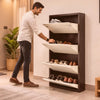
The best shoe rack for an Indian home is the one sized one notch above your current pair count, built from powder-coated mild steel, ventilated, and backed by a warranty. For most families, that means a wall-mounted 4-door steel rack holding 12–15 pairs. Steel outlasts MDF and plastic in Indian humidity, wall-mounting frees your floor, and with new furniture-quality regulations rolling out in India, a rack from a certified, warrantied manufacturer is the safe default.
A shoe rack is the least glamorous thing you'll buy for your home and, per rupee, one of the most used. It's the first thing guests see and the last thing you touch on the way out. Yet most people buy one in a rush, pick the wrong size, and are back shopping within a year. This guide is built to stop that from happening — with the sizing maths, the material trade-offs that actually matter in Indian conditions, where a rack should sit, and the current rules that quietly changed what "safe to buy" means in 2026.
Start with the honest reason the pile keeps coming back: Indians own more shoes than they used to, and the trend line is steep. Average footwear consumption in India is projected at around two pairs per person in 2026, with the market heading toward four billion pairs a year by 2030. That still looks modest until you see where it's going.
The Council for Footwear, Leather & Accessories notes India's per-capita footwear consumption of roughly 1.66 pairs a year sits well below the global average of about three pairs, and far under the six to seven pairs typical of developed markets. As incomes rise, that gap closes fast. Multiply even two pairs across a family of four, then add the sports shoes, office formals, monsoon slippers and festival juttis nobody throws out, and the entryway loses the battle.
The scattered-shoe habit carries a measurable cost. In a peer-reviewed study, UCLA researchers found that women who described their homes with more clutter-related language showed flatter daily cortisol slopes, a stress-hormone pattern associated with poorer health outcomes. (You'll see a tidy "clutter raises cortisol by 30%" figure quoted all over the internet; the actual research reported an association, not a clean percentage, and we'd rather give you the real finding than a viral one.)
More recent work backs the broader link: a 2025 review in the Journal of Environmental Psychology found home clutter correlates with lower mental wellbeing and life satisfaction, with the load often falling hardest on whoever manages the household. A clear entryway isn't about impressing visitors; it's one of the cheapest daily stress-relievers you can install.
There's a hygiene case too. Footwear tracks soil contaminants and bacteria in from outside, which is exactly why so many Indian households now keep dedicated storage at the threshold. An organised rack confines that dirt to one spot and makes cleaning easier. A closed rack also protects the shoes themselves: leather formals and rubber soles last longer aired and off a damp floor than baking in a heap. One product, three jobs — it de-stresses the space, contains the dirt, and extends the life of footwear you've already paid for.
If it feels like everyone is suddenly buying storage furniture, the data agrees. India's home-furniture market is set to grow from about USD 25.2 billion in 2025 to USD 27.3 billion in 2026, and to reach USD 40.5 billion by 2031 at an 8.24% CAGR, per Mordor Intelligence.
You'll read a lot of guides claiming Indian flats are shrinking. That was true five or six years ago; it isn't the current story. What's really squeezing homes is the loading factor — the gap between the super-built-up area you pay for and the carpet area you can actually use.
Anarock's research puts it plainly: a 40% loading is now the norm (up from a standard 30% a few years ago), and in Mumbai only about 57% of a flat's super-built-up area is usable carpet space. So even a nominally large apartment gives you less floor than the brochure suggests, which is precisely what makes a slim, wall-mounted rack more valuable than a bulky floor cabinet. Add urbanisation to the mix: India's urban population is on course to exceed 40% by 2030, up from 34.5% in 2021. More people in denser cities, less usable floor, more shoes each.
Here's the development that helps buyers most directly. India's Furniture (Quality Control) Order makes BIS certification mandatory for covered furniture, with household storage units falling under standard IS 17634:2022. Enforcement began in February 2026 for medium and large manufacturers and importers, with a 13 August 2026 deadline for micro and small enterprises.
Translation for the average shopper: flimsy, uncertified storage is being pushed out of the legal market, and buying from an established, warrantied brand has shifted from nice-to-have to the sensible default. Beyond the domestic BIS mark, it's worth checking a brand's international quality certifications too — CE marking and ISO 9001:2015 manufacturing certification, for instance — as independent signals of build quality. (Note the confusion floating around online: the February date is the main enforcement trigger; August 2026 is the smaller-maker extension, not the overall deadline.)
Material is the single biggest decision, because it dictates how long the rack survives Indian weather. Here's how the four common options actually behave.

Powder-coated mild steel is the workhorse. The coating is the detail that matters; a baked-on finish is far tougher than paint, wipes clean, and is what lets a good maker back a steel rack with a multi-year warranty.
Engineered wood delivers a furniture-like look cheaply, but moisture is its undoing near an Indian entryway.
Solid wood is beautiful and sturdy, but it's a décor statement more than a value buy.
Plastic wins only on price and waterproofing; as a long-term family solution it's a false economy.
One under-used way to judge steel quality without a spec sheet: weight. Product literature rarely lists gauge, but net weight is a fair proxy for how much metal is actually in the frame. Equal's steel racks, for instance, are published at 17.2 kg for the 3-door, 21.2 kg for the 4-door and 28.5 kg for the 5-door. A "steel" rack that weighs a fraction of that is running thinner-gauge sheet, the kind that flexes under a row of boots.
The honest verdict: for a home that wants one rack to last a decade, powder-coated steel is the sweet spot of durability, capacity and price. Solid wood wins on looks; plastic wins on budget; steel wins on staying power.
Material is what it's made of; type is how it fits your home. Two racks of identical steel can suit completely different flats depending on form.
Wall-mounted racks are the answer to squeezed floor plans. Nothing touches the ground, so you reclaim usable floor and can mop underneath in seconds; anchored to the wall, they don't topple, and they suit narrow entry corridors a floor unit would block. This is the format Equal specialises in.
Freestanding cabinets offer big capacity behind doors and a living-room finish, but they eat floor and are awkward to clean around.
Open shelf racks are cheap and superbly ventilated, but everything's on display and collecting dust — fine for a utility area or balcony, not a formal entrance.
Shoe benches add a seat for tying laces, a real help for elderly family members, but hold few pairs, so they work as a second unit.
Over-the-door organisers are cheap and space-saving for a rented room, but flimsy and low-capacity — a supplement, never the main rack.
Work through these roughly in order; the early points matter most.
Sizing is where satisfied buyers separate from frustrated ones. Use household size as your anchor, then adjust for how shoe-heavy your family is.
Specifications and prices as listed on equal.store at the time of writing; check the live product pages for current pricing and offers.

Couples and small families (6–12 pairs): A 2- or 3-door rack fits a couple, a single professional or a 1 BHK neatly, without dominating a small entryway.
Families of three to four (12–15 pairs): This is the sweet spot for most Indian households, and the 4-door is the single most popular size for a reason — it balances height and capacity for a 2–3 BHK. The Equal 4-door rack stores 12–15 pairs, enough for a family plus a little guest overflow.
Large and joint families, hostels and shops (15–18 pairs): Multi-generational households, guesthouses, offices and shops should go straight to a 5-door, which uses full wall height to store 15–18 pairs. Bulk buyers can arrange trade pricing through the Equal B2B desk.
The one sizing rule that never fails: when you're stuck between two sizes, buy the bigger one. An empty extra shelf costs nothing; running out of space costs you a second purchase.

In many Indian homes, where the rack goes is considered as important as which one to buy — and reassuringly, tradition and practical logic mostly agree.
The directions most sources recommend: Across leading guides, the consensus is consistent — the west and south-west zones are preferred for a shoe rack, with the south acceptable as a backup. If a rack sits near the entrance, keep it to one side so it never blocks the doorway or the flow of movement.
Directions to avoid: The strongest agreement is on what to steer clear of. Vastu discourages the north-east, the prayer-associated zone, along with the north and east, and piling footwear directly at the main entrance. A commonly cited practical rule is to keep the rack below knee height and closed.
The takeaway under the tradition: Strip away the belief system and the advice is simply good housekeeping — keep the entrance clear so no one trips, contain outdoor dirt to one spot, store the rack low and closed so it looks tidy, and declutter it regularly. Whether or not you follow Vastu, a wall-mounted, closed rack set neatly to one side of the door achieves all of it. Traditions differ on a few directions, so treat placement as a personal choice rather than a strict rule.
Even careful buyers fall into a handful of predictable traps. Sidestep these, and you'll get it right first time.
Equal has been building storage and home-utility products for Indian homes since 2001. Every metal shoe rack in the range is engineered around the exact priorities this guide recommends: a powder-coated mild-steel body with a rust-resistant finish, a central locking system that secures all doors with a single key, ventilated doors that let footwear breathe, and pre-drilled mounting holes so wall installation is straightforward. Every rack is manufactured to CE and RoHS standards and built under ISO 9001:2015 quality management, all backed by a 3-year warranty and free delivery across India.
The range is deliberately simple, so choosing is easy:
Each comes in three finishes: Black for modern interiors, Brown as the do-everything neutral, and Ivory for light, bright entryways — all using the identical steel and coating, so the choice is purely aesthetic. Whether you call it a chappal stand, a slipper stand or a shoe cabinet, it's designed for real Indian footwear, from monsoon slippers to office formals.
If you're kitting out a whole entryway, it's worth browsing the matching safe lockers and aluminium ladders from the same range.
The best shoe rack isn't the prettiest or the cheapest; it's the one sized correctly, built for your climate, ventilated against odour, and backed by a warranty. If that points you toward a wall-mounted steel rack, explore the full Equal shoe rack range: three sizes, three finishes, a central lock, ventilated doors, a 3-year warranty and free delivery across India from a brand that's been organising Indian homes since 2001.
Powder-coated mild steel offers the best balance of durability, load capacity, rust resistance and price for India's humidity and heavy daily use. Solid wood is the premium choice for looks; plastic works only as a cheap, short-term or bathroom option. Match the material to location: humid or open doorways favour steel; dry indoor corners can take wood.
Count your current pairs and add a buffer. As a rule of thumb, a couple or 1 BHK suits a 2–3 door rack (6–12 pairs), a family of three to four fits a 4-door (12–15 pairs), and large or joint families need a 5-door (15–18 pairs). Since boots and sports shoes take more room than sandals, size up when you're between options.
For compact Indian homes, wall-mounted usually wins: it frees floor space, makes cleaning underneath easy, and is very stable once anchored. Freestanding cabinets suit homes with floor to spare and a preference for furniture-style pieces. Your wall type and willingness to drill are the deciding factors.
None, really. "Chappal stand," "slipper stand," "shoe cabinet" and "shoe rack" are regional names for the same product. A well-built metal rack handles every kind of Indian footwear — chappals, sandals, sports shoes and formals — so the label matters far less than build quality and capacity.
Most Vastu guidance recommends the west or south-west of the home, with the south acceptable as a backup, while advising against the north-east, north and east, and against piling shoes at the main entrance. Keeping the rack low, closed, to one side of the door, and regularly decluttered satisfies both tradition and plain good housekeeping.
Airflow is the fix. Choose a rack with ventilated doors, let wet shoes dry before shelving them, and add silica-gel sachets or a small odour absorber inside. A monthly clean-out — wiping shelves and removing shoes you no longer wear — stops smell taking hold.
For a long-term family solution, yes. Plastic is cheaper upfront but light-duty, prone to tipping and quick to look worn. A powder-coated steel rack lasts years, carries heavier footwear, resists rust and usually offers better value across the product's life even though it costs more on day one.
For covered storage furniture from larger makers, effectively yes. Household storage units fall under IS 17634:2022, and enforcement of the Furniture (Quality Control) Order began in February 2026 for medium and large manufacturers and importers, with micro and small enterprises given until 13 August 2026. In practice, this is pushing the market toward branded, warrantied manufacturers with clear quality credentials — when comparing options, look for certifications such as CE marking or ISO 9001:2015 alongside the warranty terms.
Yes. Equal supplies metal racks in bulk to hostels, hotels, offices and shops across India, usually with trade pricing. For multiple units, contact the B2B desk directly rather than buying single units at retail; you'll get better rates and coordinated delivery.